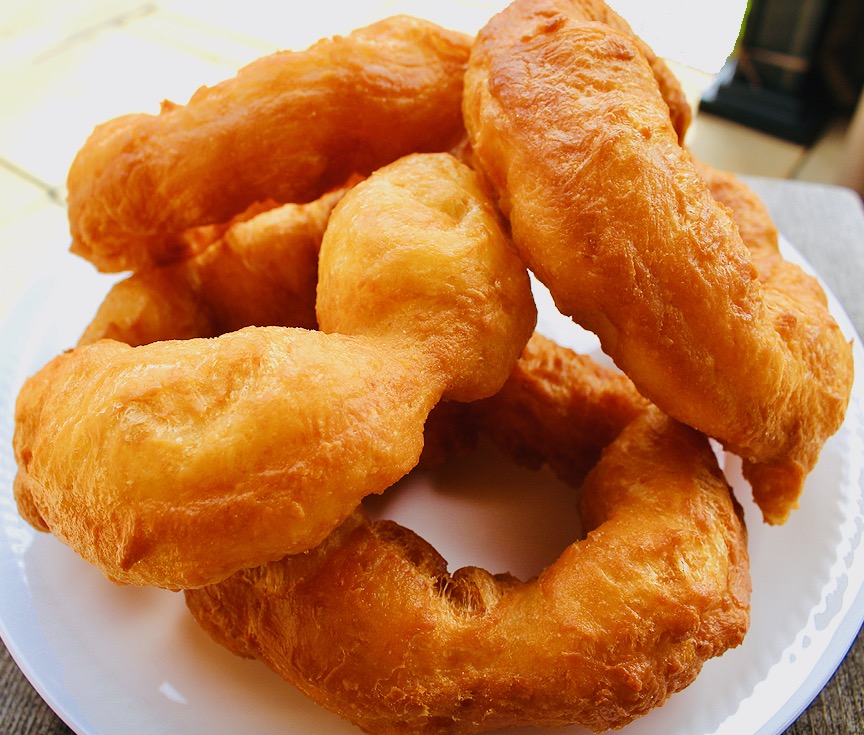
These flour and potato based fried rings have a rich history. They can be traced back to ancient Greece. The name, ‘Cuddrurieddri‘ derives from the Greek word ‘kollura‘ which means crown.
I wouldn’t go as far and say that Consentini, folks from the province of Cosenza, in the region of Calabria, are obsessed with Cuddrurieddri, but they are proud of this delicacy. Its a recipe based on tradition and made predominantly during the Christmas season. In fact, they are made on the eve of the Feast of the Immaculate Conception to celebrate the start of the Christmas season. Family will gather together and make them in large batches and enjoy them together. However, just like other foods and traditions, exact dates and recipes vary from town to town within the province of Cosenza. Some will begin making them after All Souls Day in November to kick off the Christmas season.
They are best eaten piping hot right out of the fryer, either plain as a street-food type snack or paired with cured meats, olives, local cheeses, and wine. Families will make large quantities fried as a simple ring or stuff them with anchovies, called Vecchiareddre, in the form of a pocket and then fry them. Adding the achovies makes them more savoury.
Just like the recipe and tradition varies slightly from town to town, so does the dialect. For example, Consentini will say ‘cuddrurieddri’ and ‘vecchiarieddre’. Meanwhile in neighbouring towns throughout the Cosenza province (such as Rende, Rogliano, and surrounding areas) to soften the harsh double-dd they pronounce them as ‘cullurielli’ and ‘vecchiarelli’ instead. They replace the double -dd with -ll. So instantly during a conversation, one can detect the others hometown from how they use the double-dd or not!
Cuddrurieddri, and its anchovy stuffed cousin are a prime example of ‘la cucina povera’. Which basically means ‘poor kitchen’, which is fairly accurate based on recounts shared by my parents. The ingredients needed to make them is proof. Flour which was readily available from the land, potatoes from their land or nearby Sila and anchovies or sarda, which are preserved sardines. Preserved because refrigeration was a luxury. I’m not referring to 100 years ago. Instead I’m referring to about 75 years ago. Electrification had barely reached the more remote area. Therefore, they were dependant on techniques like preserving with oil or salt to make sure food would last until the next planting and harvesting season.
With simple flour and potatoes, and possible anchovy, with some Greek influence, they created this delicious food. The moment, the word Cuddrurieddri is mentioned, ears perk up and attention shifts. A food so simple can stir such excitement. Adding potatoes to the dough creates a wonderful crunchy texture on the outside and soft in the inside. It take some time and a little technique to get the dough ready (Cuddrurieddri). All good things require two ingredient that are never listed or mentioned, time and work. And just like many other Italian (or Calabrian) foods, simple ingredients are transformed into something flavourful and memorable.
Honestly, sometimes I contemplate if making them is worth all the trouble. It’s a lot of work. But, the moment you take a bite when it comes right out of the fryer you feel satisfied. The smart thing is to make it a social affair. All the help makes a big difference. The workload is divided and so is the bounty. That’s fine since they are made in large batches. Also, it’s foolish to think that just cuddrurieddri and vecchiareddre will be on the menu. A huge spread accompanies the fritters. Just imagine olives, cured meats, cheese, rapini, salad and, of course wine.
This is exactly what I planned, but outdoors. It’s so liberating and pleasurable to eat outdoors. Literally, we prepare, make and eat. Simple and straight forward. This is the best time of the year to do this. Not necessarily because of tradition. Im referring to the cooler autumn temperature. It’s simply more comfortable.
This is the type of food you don’t easily find at some Italian restaurant or eatery. It’s a tradition that is steadily fading with the previous generation. Personally, it makes me sad to see this knowledge lost. Ancient techniques, traditions and recipes will disappear. No, you cannot rely on AI to solve this problem. A lot of the recipes online are simply inaccurate or have been modified to garner attention. Many just care about the flavour and couldn’t care less about authenticity. There are a few like me who care and are documenting this information. I’m happy to share and happy for the few that find their way here to collect accurate information.
Therefore, if you want an authentic taste of this delicacy check out my recipe.
Enjoy!